September 26, 2025
LGBTQ Agenda: Science and the queer experience explored in lecture series
John Ferrannini READ TIME: 4 MIN.
How people can understand the LGBTQ life and culture through the lens of science is one of the burning questions behind a new lecture series in New York City. The series is rising in popularity and gaining traction on social media.
Living Room Lectures is the brainchild of Adam Nye, a 38-year-old gay Brooklyn man who started hosting the events in his living room back in October 2023. (No relation to William Nye, aka Bill Nye, the Science Guy.) Those initial gatherings brought a good 18-20 people, but now, “It’s become so popular that we expect to have public, ticketed events on a bimonthly basis,” he said. That started earlier this year.
Nye said it began as a way for people in the New York queer nightlife scene to get together “outside of the typical social spaces” after they were looking “for opportunities to participate in shared learning.”
Nye himself has presented two lectures since that initial 2023 founding – the most recent was on the topic of “reclaiming play as queer adults.”
“My background is in education and child development, and my grad studies focused on defining play and making a case for applying the play principle to other living environments and situations,” Nye said.
“What I did was started talking about the neuroscience of play, defining meaningful play experiences, and talking about the experience a lot of queer people have as far as their play being suppressed and policed as children and the negative impact that has on us as children and adults, and explaining what it could mean if we, as queer adults, had a meaningful play life while also recognizing a lot of actions and rituals within the adult community are very playful – from the slang to ballroom performance to kink,” he added.
The third public, ticketed lecture was earlier this month, Nye said.
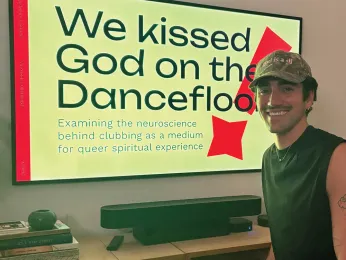
Alexander Dillabaugh, a queer man who has a degree in neurobiology, physiology, and behavior from UC Davis, and is beginning graduate studies at the University of Cambridge, presented the most recent lecture, which touched on the similarities in the neuroscience between clubbing and spirituality.
Dillabaugh told the B.A.R. he drew on the work of Patrick McNamara, author of “The Cognitive Neuroscience of Religious Experience,” and the late anthropologist Victor Turner, who wrote about symbolism, rituals, and rites of passage “as a form of access to group spirituality,” Dillabaugh said.
Turner “looked at dance as a medium that syncs people via beat, rhythm and movement and made the argument that it syncs people into a collective whole,” Dillabaugh said. Therefore, “the dance floor can be an entity greater than the individual dancers,” as individuals contribute to and receive energy from it.
Dillabaugh said the lecture resonated with a lot of regular nightlife workers and attendees.
“This lecture got a lot of positive feedback,” he said, particularly on Instagram.
“A lot of people attending were DJs and promoters and dancers. Selling the idea of clubbing as a form of religious experience wasn’t that hard of a sell, and they felt it validated their experiences,” he said.
Nye said the lectures are inspired by the salons of pre-revolutionary France, Enlightenment social and intellectual gatherings that inspired the likes of Voltaire.
“Any topic is on the table,” Nye said. “They [presenters] just have to make it queer, and that’s the broadest definition of queer.”
Among topics considered have been redefining power dynamics in the queer community, pornography, art, and natural selection.
“We want to explain a lot of topics through the queer lens,” Nye said.
After about 30 minutes for the lecture, there is an hour of open discussion among the participants, followed by a call to action. Those discussions, Nye said, are “where the true magic of the event happens.”
After Dillabaugh’s lecture, the group discussed what responsibilities queer community members have to each other in cubbing spaces.
“That was a big part of the group conversation,” he said. “How does looking at dancing like this, as a spiritual experience, change our approach to it? There were a lot of personal stories.”
Part of that conversation touched on the use of drugs, how both sober people and those who use drugs should treat one another, and the dangers of ignoring the potential downsides of drug use.
“There is a danger here – to look at partying as a spiritual experience,” Dillabaugh said. “Glorifying it can make you overlook more serious aspects as well.”
Attendee Janae Marable, who is queer, stated, “Alex put science behind the feeling of joy we get in being in community with one another as we compete against archaic structures. The presentation was a beautiful display of how our brains are wired to connect with one another and just how crucial research in dance spaces is. He proved the club is church.”
Marable continued, “If the club is the church … then living room lectures is the steeple. The people brought together that night had such thoughtful, witty and provocative insights – truly the place to be.”
Nye invites people who are interested in attending the lecture series to sign up for regular updates via his website .
“The way we do the ticketing is it’s an invite lottery,” Nye said. “People can sign up on a form we send out and we randomly select 20 names.”
Living Room Lectures has already amassed a sizable following on Instagram, at over 6,000.
LGBTQ Agenda is an online column that appears weekly. Got a tip on queer news? Contact John Ferrannini at [email protected].